Dimensions,
for Jess
A picture-first walk from a single dot, up through our world and time, out to the edge of imagination, and then into the thousands of dimensions an AI thinks in.
What is a dimension?
A dimension is a direction you can move in that is completely separate from the others. Another way to say it: it's how many numbers you need to say exactly where something is.
Imagine someone left a vinyl record for you at a hotel. To find it, you need an address. Each dimension adds one more number to that address: how far along the shelf, which spot in the lobby, which floor, and what time it's there.
A point: nowhere to go
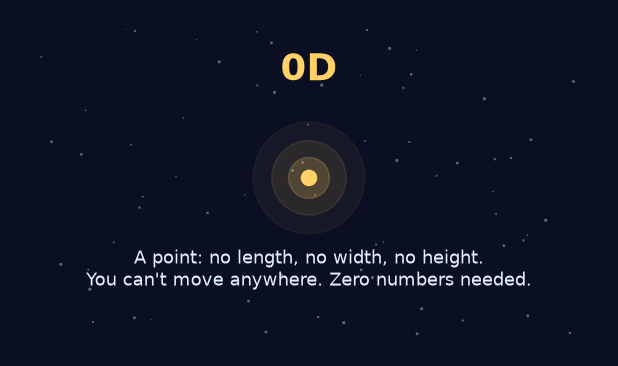
A point has no length, no width, no height. If you lived inside a point, you couldn't move at all, and you'd need zero numbers to say where you are, because there's only one place to be.
It sounds like nothing, but it's the seed of everything else.
A line: one number
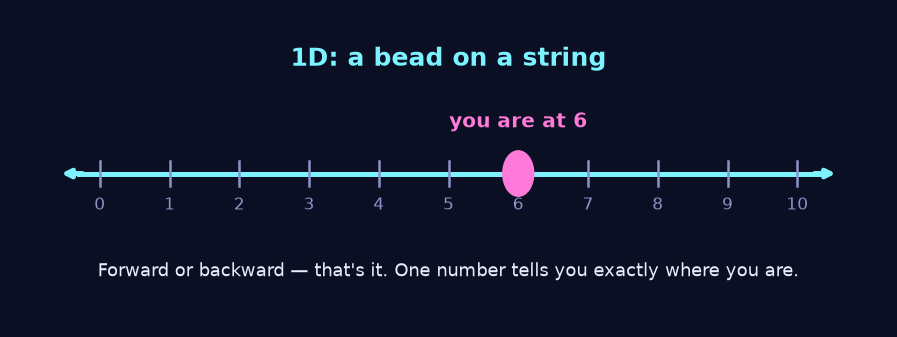
Drag the point in one direction and you get a line. Now there's one way to move (forward and backward are the same direction, just opposite ways), so one number says exactly where you are.
1D things you already use
- The progress bar on a YouTube video: "2:41" is the only number you need.
- A thermometer, a train track, a ruler, the volume slider.
- A shelf of records: "the 6th one from the left."
A flat world: two numbers
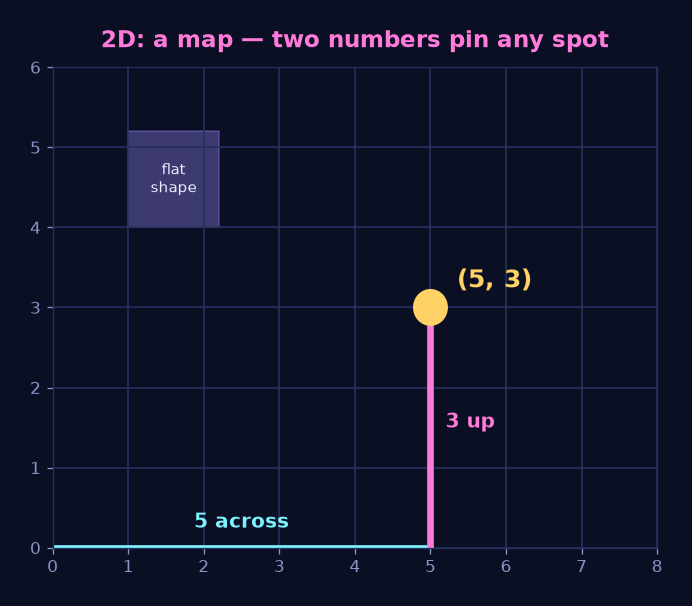
Drag the line sideways and it sweeps out a flat sheet. Now there are two separate directions: across and up (or east and north). You can change one without touching the other, so you need two numbers, like (5, 3).
2D things you already use
- Your phone screen: every tap is an across-and-down position.
- A map or GPS pin (latitude and longitude). A chessboard works the same way: "e4" means column e, row 4.
- A shadow: a flat copy of a 3D thing.
In 1884, Edwin Abbott wrote a little book called Flatland about a square who lives on a flat sheet. He can't imagine "up." It isn't left, right, forward or back, so to him it simply doesn't exist. Keep him in mind; he's how we'll sneak up on 4D.
Our world: three numbers
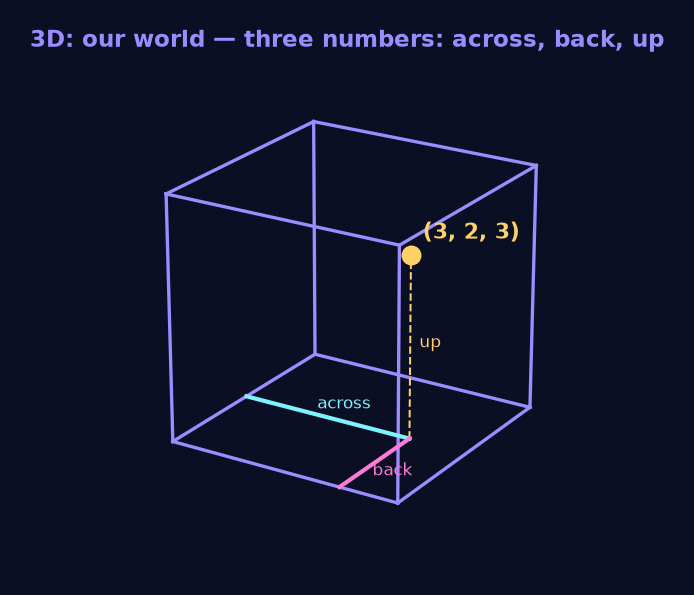
Lift the flat square straight up and it sweeps out a cube. That's the world we live in: across, back, and up. The record is 3 steps across the lobby, 2 steps back, on floor 3: (3, 2, 3).
A cool fact about your own eyes
Each eye only sees a flat, 2D picture, like a photo. Your brain compares the two slightly different photos and builds the third dimension, depth, for you. You're already doing dimension-math every second.
4D: two different ideas share the name
This is where people get mixed up, because "the fourth dimension" means two different things. Both are real ideas, but they're not the same thing.
Idea A · Time
Physics treats time as a 4th number you need to describe an event. Not just where, but when. Einstein's relativity weaves space and time together into spacetime.Idea B · A 4th direction of space
A mathematical "extra direction," at right angles to across, back and up. We can do the math perfectly, but we can't point to it. Its famous shape is the tesseract.Idea A: time, the 4th number
The DJ plays a record at 8 p.m. and again at 10 p.m. Same booth, same three space numbers, but two different events. To tell them apart you need a fourth number: the time. (3, 2, 3, 8 p.m.) and (3, 2, 3, 10 p.m.).
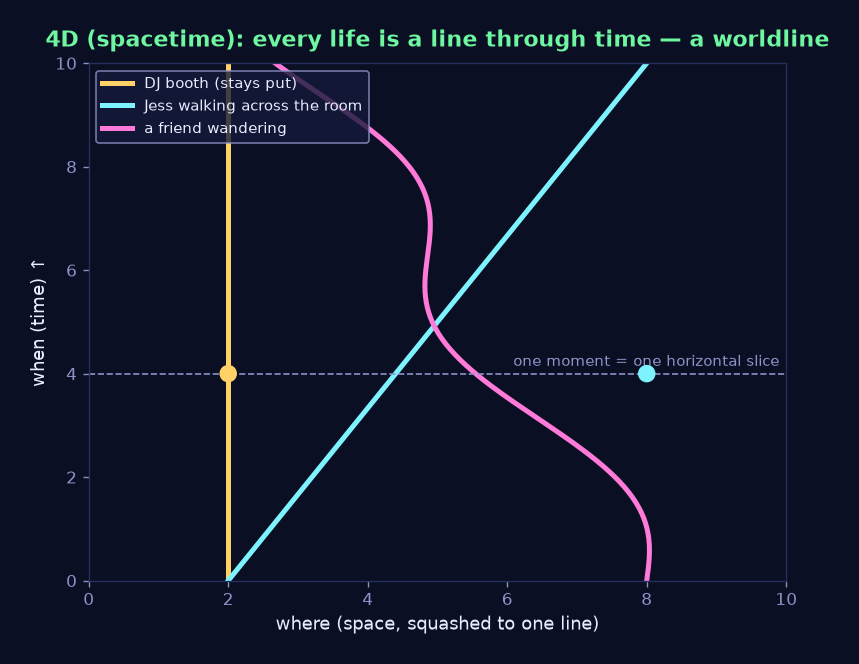
A worldline is the path of your whole life drawn through spacetime. Something that stays put is a straight line going up. Something moving leans sideways. Meeting someone means your worldlines cross: same place, same time.
Idea B: a 4th direction of space, and the tesseract
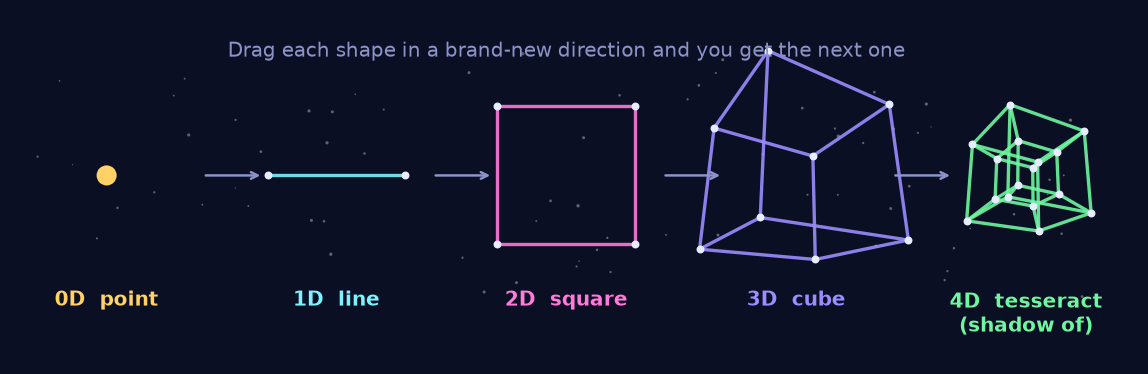
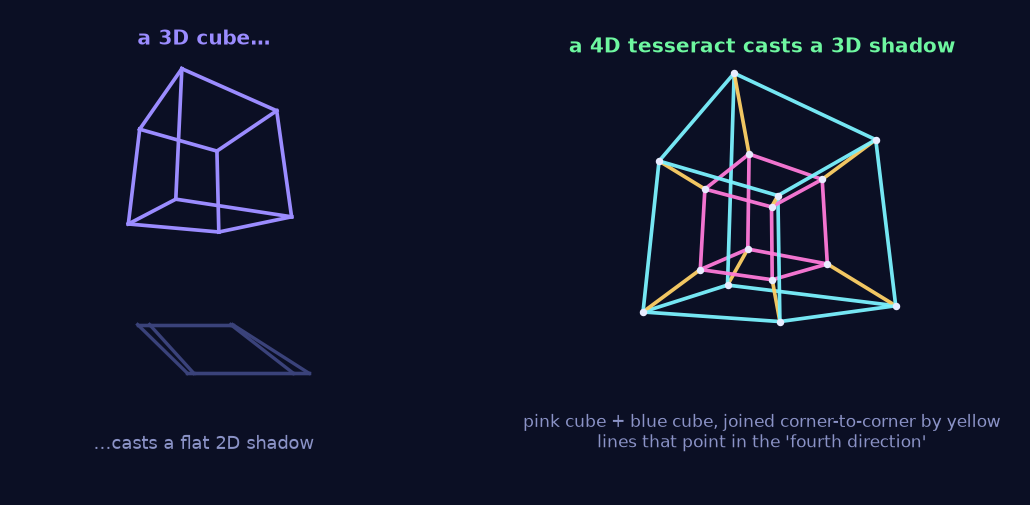
Follow the pattern we've been using: drag a point to get a line, a line to get a square, a square to get a cube. Now drag the cube in a direction at right angles to all three. You get a tesseract (also called a hypercube).
| Shape | Dimensions | Corners | Edges |
|---|---|---|---|
| point | 0 | 1 | 0 |
| line | 1 | 2 | 1 |
| square | 2 | 4 | 4 |
| cube | 3 | 8 | 12 |
| tesseract | 4 | 16 | 32 |
Corners double each time. We can't see a tesseract, but we can count it perfectly. That's the magic of math: it walks where our eyes can't.
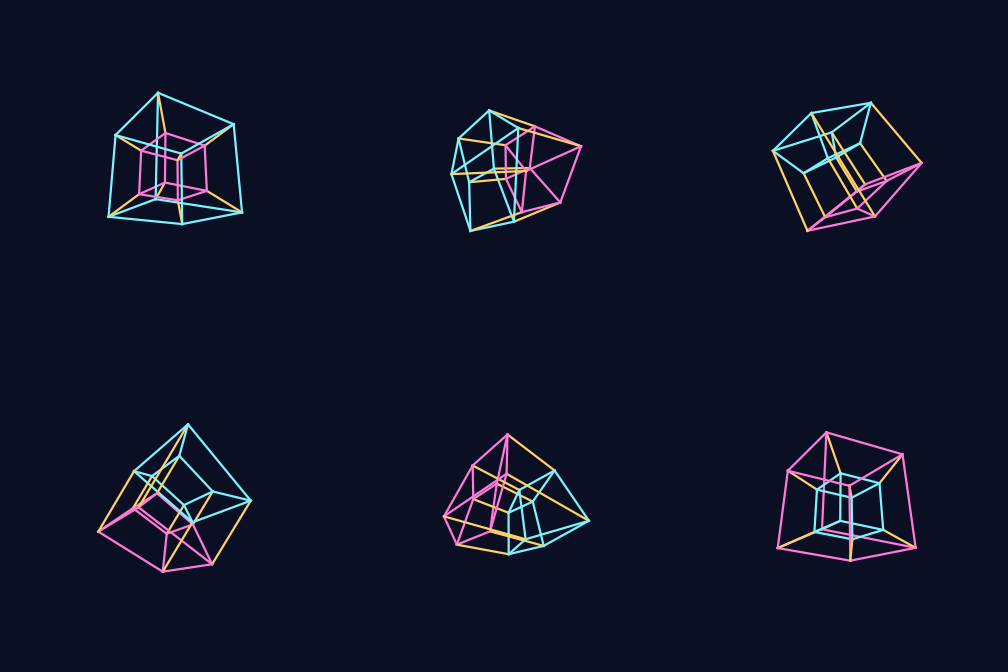
Play with it: spin a tesseract yourself
Slide the yellow one: the inner and outer cubes swap places, turning inside out. No 3D object can do that, which is your clue there's a 4th direction involved.
The Flatland trick: how a 4D thing would look to us
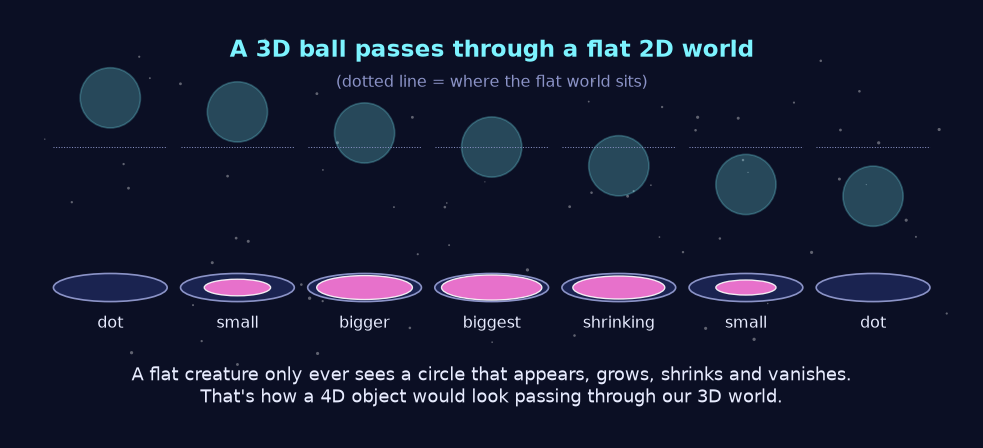
If a ball fell through Flatland, the flat square would see a dot appear from nowhere, grow into a circle, shrink, and vanish. He'd never see "a ball," only slices of it.
If a 4D ball passed through our world, we'd see the same thing one step up: a tiny sphere appearing out of thin air, swelling, shrinking, and disappearing. That's the best intuition anyone has for spatial 4D.
Beyond 4: where facts end and imagination begins
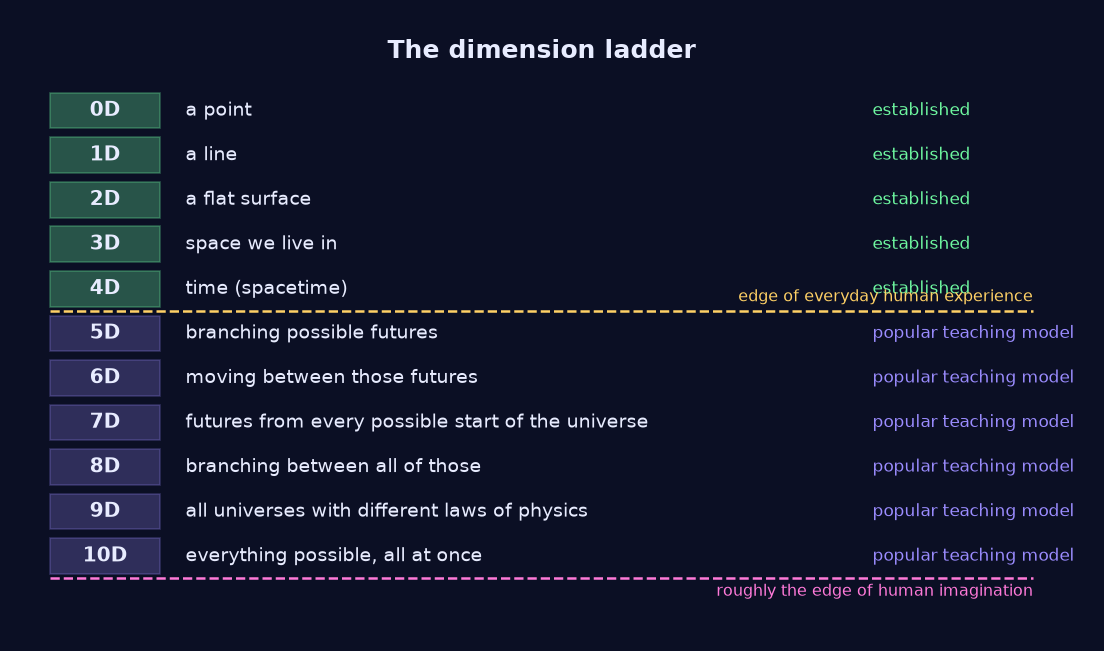
Past 4D, it's important to separate what physics actually says from a popular way of picturing it. Both are interesting, but only one is science.
- Everything we've measured fits 3 dimensions of space + 1 of time.
- In the 1920s, Kaluza and Klein tried a 5th dimension to unite gravity and electromagnetism.
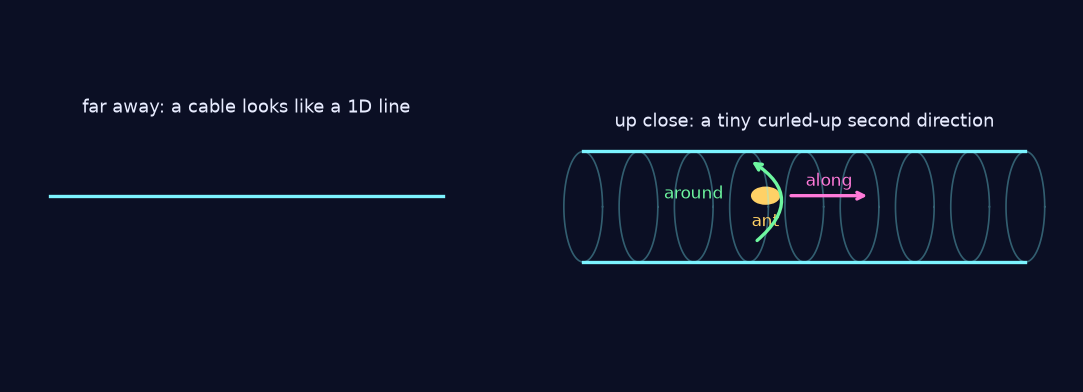
- Superstring theory needs 10 dimensions (9 space + 1 time); M-theory uses 11. The extra ones would be curled up far too small to notice.
- These are serious, beautiful mathematical ideas, but no experiment has confirmed extra dimensions yet. The Large Hadron Collider looked for signs and hasn't found them.
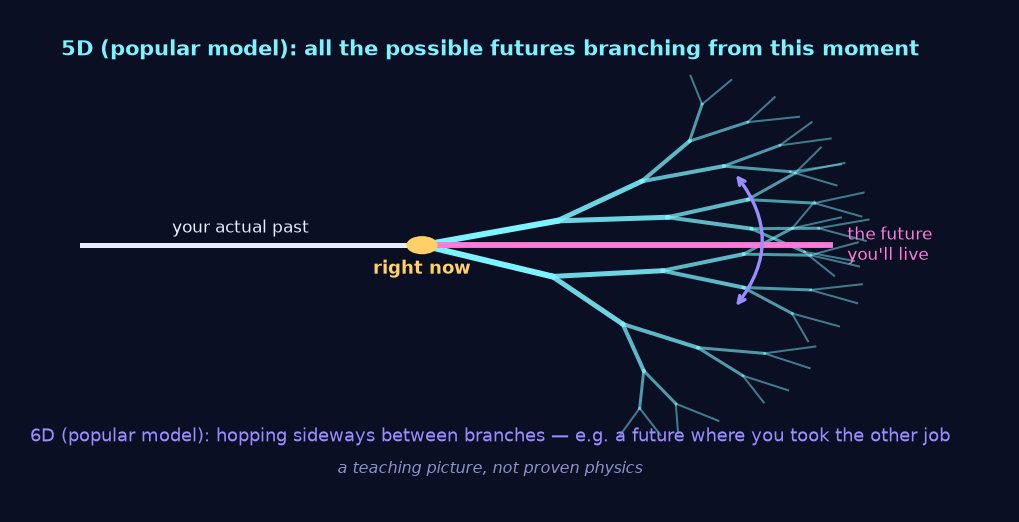
| In the popular model… | imagine |
|---|---|
| 5D | All the possible futures branching out from this exact moment. |
| 6D | Moving sideways between those branches, like the version of tonight where you stayed in. |
| 7D | Every possible future from every possible beginning of the universe. |
| 8D | Branching between all of those whole sets of possibilities. |
| 9D | All of that, for universes with completely different laws of physics. |
| 10D | Everything that could ever possibly be, all at once. |
The edge of human comprehension
By 9D and 10D, even the teaching model is describing "all possible universes." That's about as far as a human mind can stretch with pictures and stories. Past this point, people stop imagining and just calculate.
Which is exactly where computers feel at home.
How an AI uses thousands of dimensions
Here's the twist: AI uses far more dimensions than 10. Modern models work with hundreds to thousands, and it's not science fiction. It's ordinary math running on ordinary chips.
Step 1: a word becomes a long list of numbers
Remember the hotel address? 3 numbers found a spot in a room. An AI gives every word, sentence or song description an "address" too, just a much longer one, called an embedding:
"Virtual Insanity" → [0.12, −0.38, 0.07, 0.91, −0.22, … 1,536 numbers]
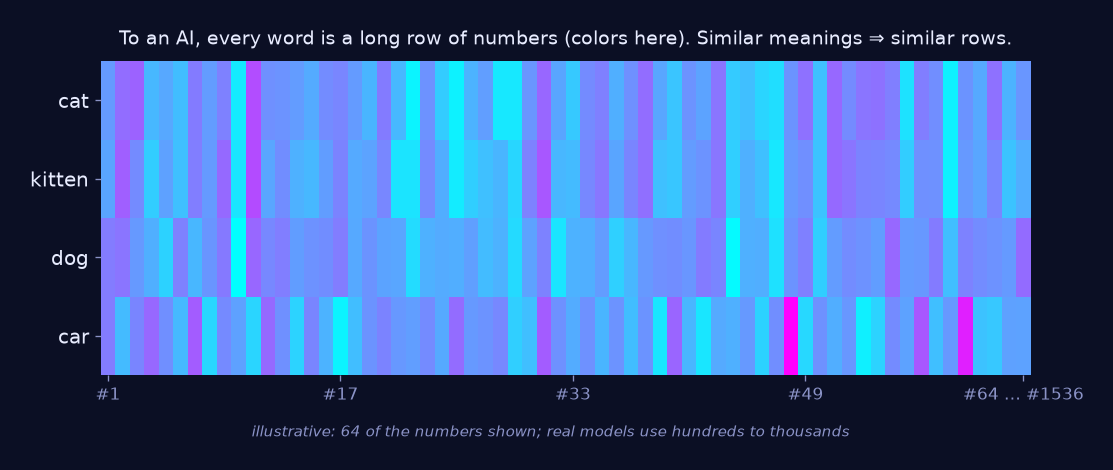
Step 2: close together = similar meaning
The AI learns those numbers by reading huge amounts of text. Words used in similar ways end up with similar addresses, so they land near each other in the space. "Cat" lands near "kitten." "Pizza" lands near "taco." "Leaky faucet" lands nowhere near "late-night DJ set."
Step 3: directions mean things
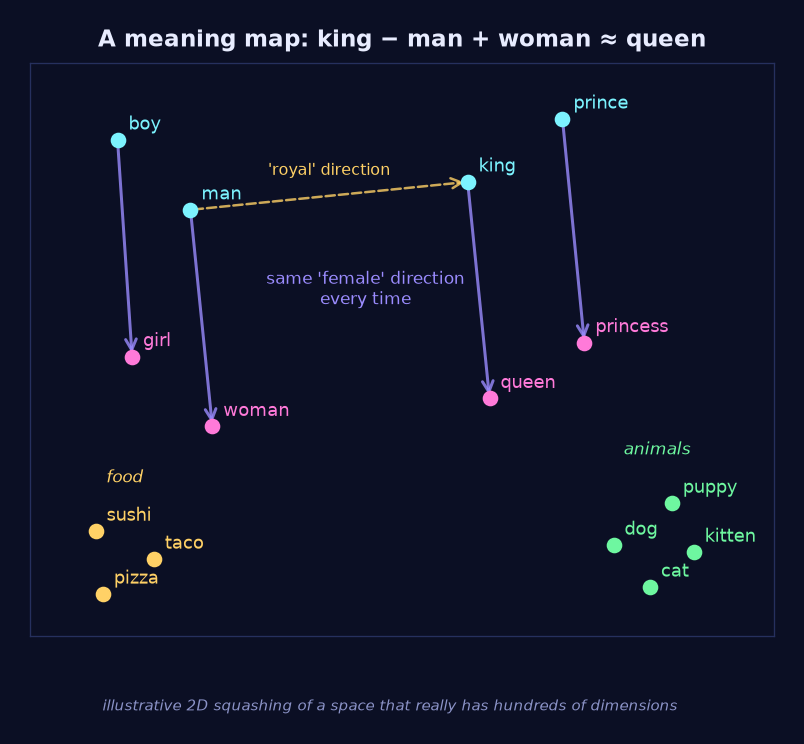
The famous discovery (word2vec, 2013): the step from man → woman points in nearly the same direction as king → queen. So you can do arithmetic with meaning:
king − man + woman ≈ queen
It's approximate. It works for some relationships and fails for others, but it shows that directions in the space carry meaning, like "more royal," "more female," "more upbeat," "more 90s."
Step 4: why so many dimensions?
Think about everything that makes a song a song: tempo, mood, era, groove, vocals, language, instruments, how it makes you feel at 2 a.m. Three numbers can't hold all that. A thousand can.
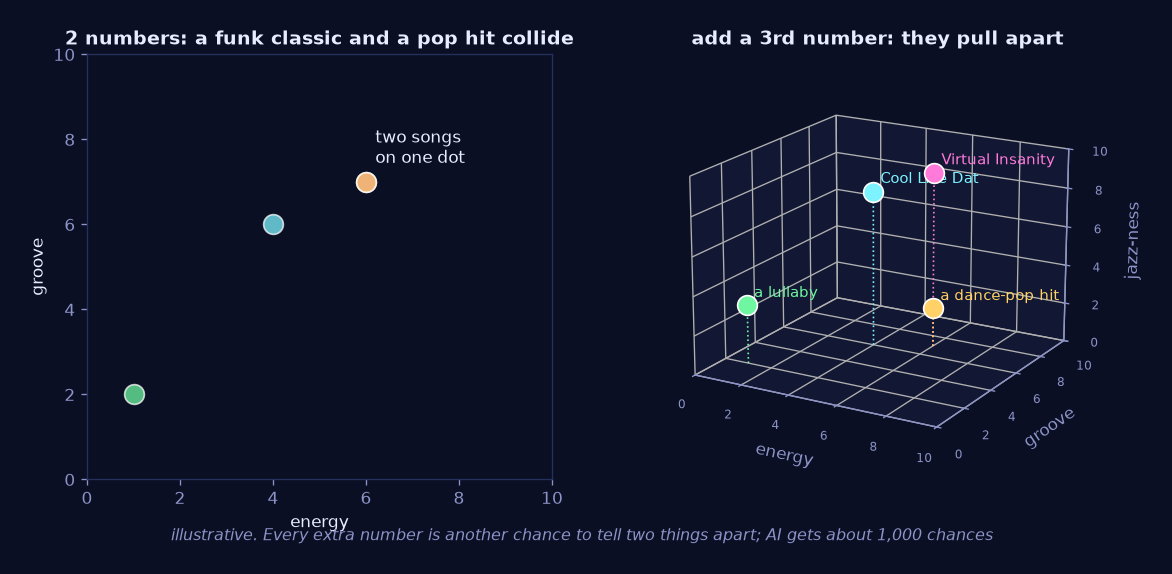
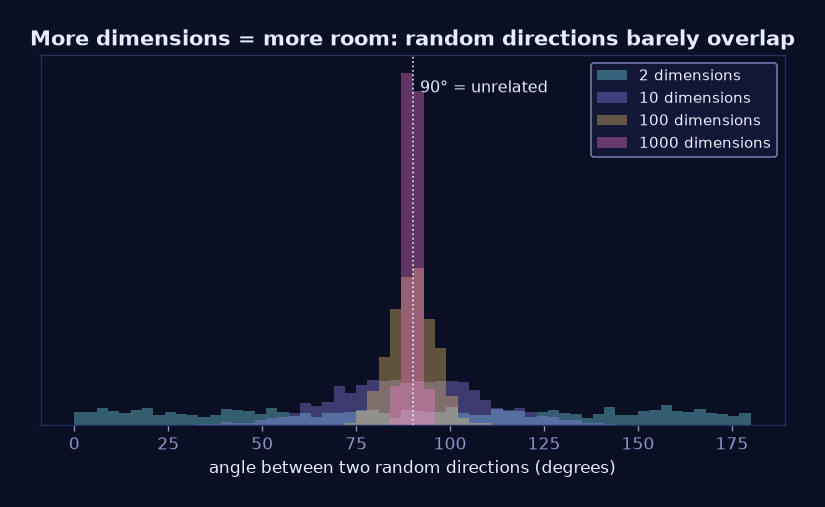
That's the super-power: high-dimensional space has enormous room. Thousands of different shades of meaning can each get their own direction without stepping on each other. So when you ask "find me songs that feel like Virtual Insanity," the AI turns your request into an address and looks for the nearest neighbours. Same idea as finding the record in the hotel, just with 1,536 numbers instead of 3.
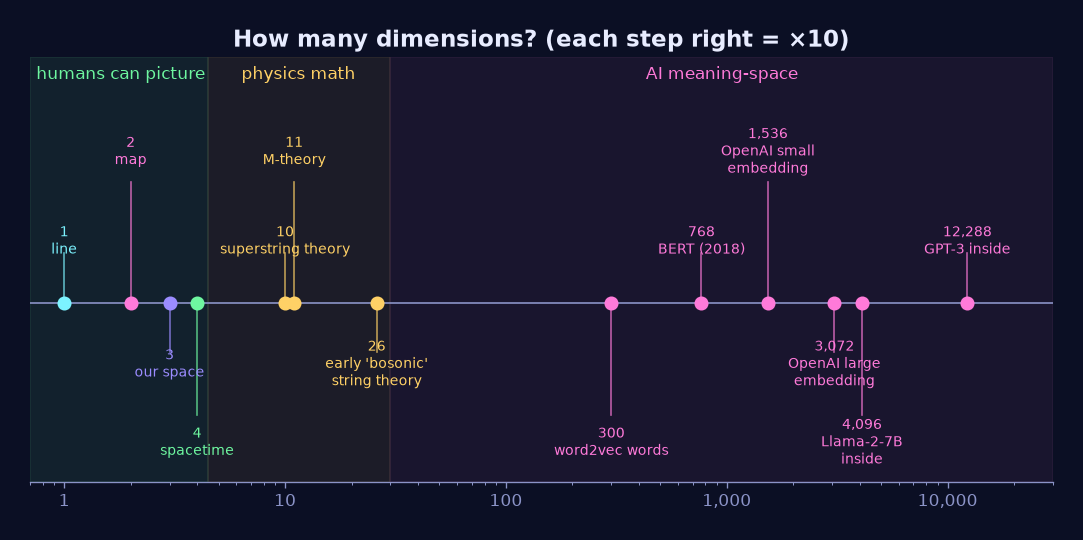
| System | Dimensions |
|---|---|
| word2vec word vectors (2013) | 300 (typical) |
| BERT-base (2018) | 768 |
| OpenAI text-embedding-3-small | 1,536 |
| OpenAI text-embedding-3-large | 3,072 |
| Llama-2-7B, internal "thought" vectors | 4,096 |
| GPT-3 (175B), internal vectors | 12,288 |
The whole trip on one card
| What it is | Numbers to find you | Status | |
|---|---|---|---|
| 0D | a point | 0 | math fact |
| 1D | a line · a video's progress bar | 1 | math fact |
| 2D | a flat sheet · your screen · a map | 2 | math fact |
| 3D | our space | 3 | lived experience |
| 4D | spacetime (time) or a 4th spatial direction (tesseract) | 4 | time: tested physics · spatial: math |
| 5–10D | string-theory extra dimensions · or the popular "possibilities" ladder | 5–11 | unconfirmed theory · teaching model |
| 768–12,288D | AI meaning-space (embeddings) | hundreds to thousands | real, running right now |
Humans live in 3, travel through a 4th, can imagine up to about 10, and built machines that think in thousands. Pretty dope.
Where these facts come from
- Edwin A. Abbott, Flatland (1884), free at Project Gutenberg
- Spacetime & worldlines: Einstein Online (Max Planck Institute for Gravitational Physics)
- GPS & relativity: R. Pogge, Ohio State
- Tesseract: Wolfram MathWorld
- Extra dimensions & the LHC: CERN
- Popular 10-D model: Rob Bryanton, Imagining the Tenth Dimension (2006), labelled here as a teaching model
- king − man + woman: Mikolov et al., 2013 (word2vec)
- BERT-base 768: Devlin et al., 2018 · OpenAI 1,536 / 3,072: embeddings guide · Llama-2-7B 4,096: Touvron et al., 2023 · GPT-3 12,288: Brown et al., 2020
Initial prompts
This page was built from Monte's request, reproduced verbatim:
ok.dope.challenge: build this better with images and dope.architecture as a standalone site(pdf and initial prompts included): write an explainer for multiple dimensions and how they work. Start with 1d and go through the known dimensions and then explain how ai can use many more dimensions than humans. Make a pdf with images along with the dimensions so Jessica can understand it. Hopefully. And You update that a little bit more with like, um, some additional graphics that actually explore that a little bit more so that you can, um, even more visual in that sense. And then a little bit more of one, two, three, four dimensions. The first four becoming the most important because those are the furthest that humans understand from my understanding. And then going on into the ninth dimension, which is like the furthest of human comprehension. And then go into your super awesomeness. Does that make sense? I'm pretty sure it does
Built on top of an earlier 8-page draft, "Dimensions, illustrated." All graphics were drawn from scratch with code (matplotlib) for this page. Embedding pictures are illustrations, not real model output.
v2 (15 Nov 2026): procedural Canvas2D animations added for the hero, each dimension, worldlines, a 4D tesseract and hypersphere slice, and an AI embedding space. Existing copy, still images, and the PDF are unchanged from v1.